WWM Homestead Planner
A web app for planning production, profit, material runway and retainer labor in Where Winds Meet. The product turns a large set of interacting recipes, slots, orders, prices and staffing constraints into a single operational planning loop.
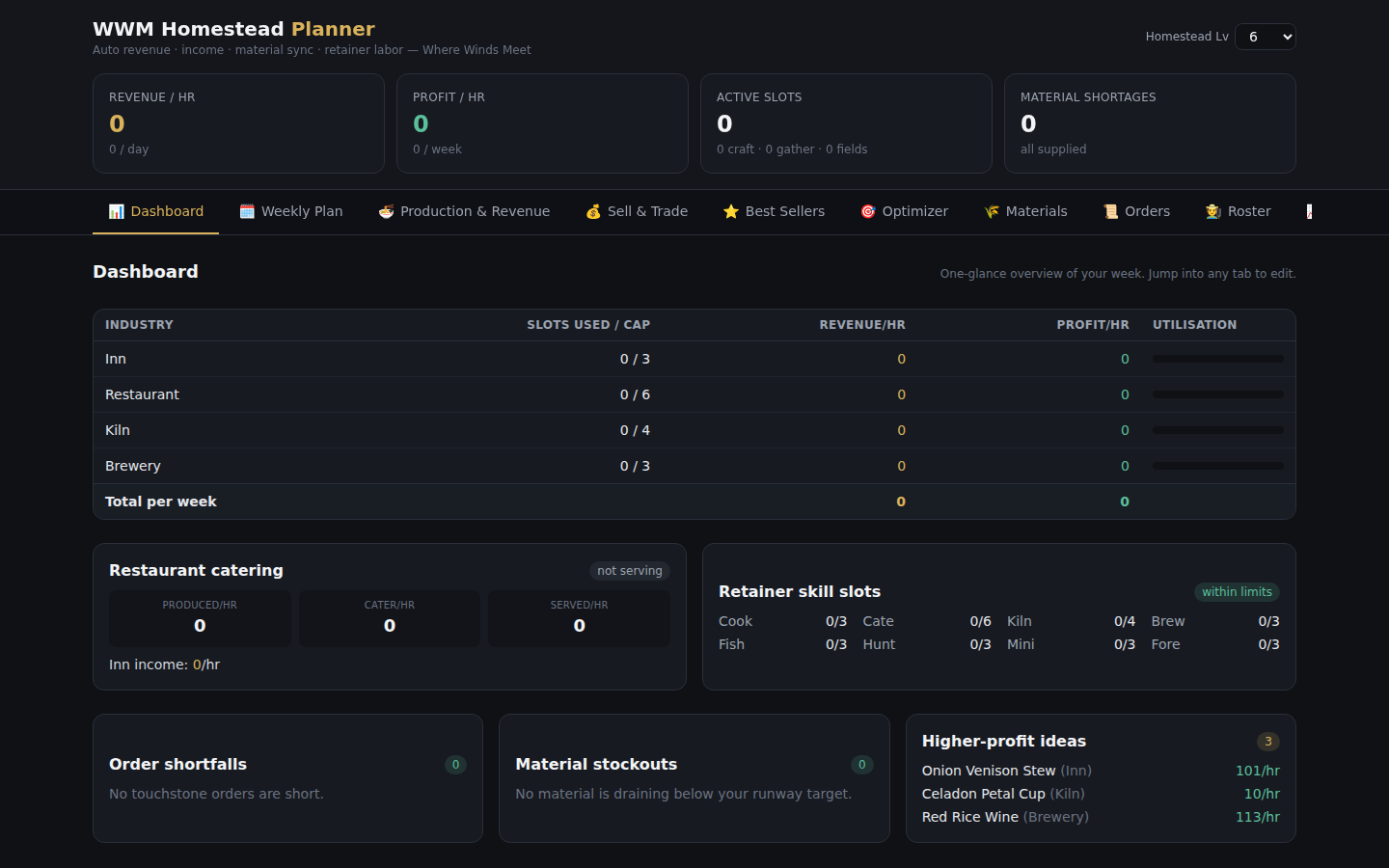
Production choices are linked to profit, stock, orders and labor at the same time.
A profitable recipe can still be a poor choice if it drains a scarce ingredient, blocks a required order or consumes the wrong retainer. The product therefore has to show system consequences, not just rank items by a single value.
Product structure, planning logic, interface design and implementation.
I organized the planning model around production queues, material flow, staffing and orders, then built dashboards and recommendations that reuse the same underlying state instead of creating disconnected calculators.
One planning state feeds every decision surface.
Production, materials, orders and roster data are intentionally connected. Editing one part of the plan changes the risk and recommendation context in the others.
A one-glance view of weekly profit, slot use, serving capacity, order shortfalls and material risk.
Plan craft lines, assign recruited retainers and compare output, prices and profit for the active setup.
Reserve short orders first, respect industry and skill-slot constraints, use a recruited retainer once and avoid runway-breaking picks when possible.
Aggregate ingredient draw against farms, gathering and intermediates to expose net rate, stock, runway and stockout risk.
Track Touchstone requirements, recruited retainers, skill levels and high-priority recruitment without separating planning from capacity.
Recommendations respect constraints before chasing yield.
The optimizer is deliberately pragmatic rather than pretending to solve a frictionless economy. It prioritizes short orders, available production capacity, recruited retainers and material runway.
Required output is protected before the planner fills remaining capacity with profit-oriented choices.
Industry and skill-slot capacity constrain the plan, and each recruited retainer can only be assigned once.
When possible, recommendations avoid choices that would push ingredients below the configured runway target.
The calculation engine combines source constants; it does not invent them.
Game constants are generated from the community Homestead Planner v2.0 and Arbiter System spreadsheets. The calculation layer combines those constants with the user's plan and roster state.
Keep data, calculation and presentation responsibilities separate.
That separation makes it easier to update game constants without hiding them inside UI code, while the same plan state can drive dashboards, recommendations and runway warnings.
The product is designed around a documented community data source and the player's own browser-stored plan. Save/share is handled through JSON export and import rather than implying an official account integration.