WWM Build Lab
A gear and combat calculator for Where Winds Meet Global. I treated it as a product problem first: make complex build data understandable, keep calculations reproducible and expose uncertainty instead of presenting every number with the same confidence.
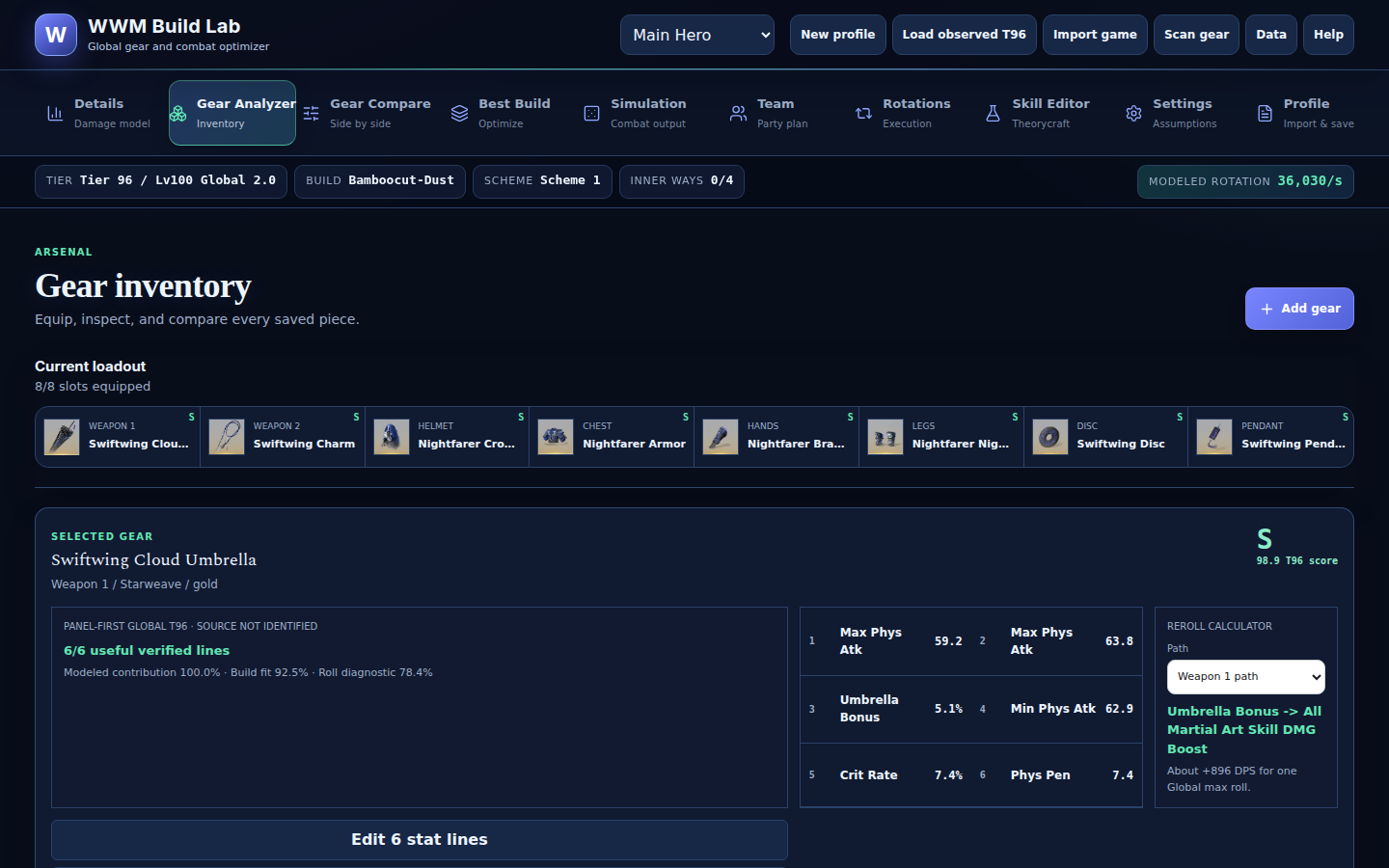
A calculator is only useful if the data behind it can be trusted.
The game exposes interacting stats, caps, weapon types, buffs and combat rules. A polished interface would still be misleading if constants from different versions or regions were mixed together without an evidence state.
Product structure, information design and implementation workflow.
I shaped the calculation experience, source-priority rules, uncertainty states and deployment checks, then iterated the interface around real build configuration and comparison tasks rather than a static dashboard mockup.
The interface is organized around decisions, not raw formulas.
The useful loop is configure → compare → understand. Data provenance and confidence stay attached to that loop so a player can tell when a result is a supported calculation and when the source is incomplete.
Choose gear and combat inputs in a structure that mirrors the decisions a player is actually making.
Caps, direct critical, Precision, Affinity and per-skill outcome eligibility are kept as distinct rules rather than flattened together.
The UI emphasizes the effect of a build choice instead of exposing a wall of disconnected constants.
Current Global evidence outranks older workbook or community references when sources disagree.
Production output includes build information so the served commit and data version can be checked.
Uncertainty is part of the interface model.
The data policy is deliberately ordered. That makes source conflicts visible and prevents lower-confidence references from silently overriding the current Global client.
Current English Global screenshots are the highest-priority source.
Official Global changes are used before workbook or community references.
The Lv100 Upper / 100上 profile supplies constants that are cross-checked against Global.
Player or dummy observations can validate behavior when they are clearly scoped.
Reference material remains lower priority and is not applied automatically when it conflicts with Global.
A complete current Global T96 Relaid Modulating cap table has not been verified. Relaid roll quality therefore displays N/A instead of being compared against standard Tier 96 caps as if the missing table were known.
A live calculator needs a verifiable production state.
The project is deployed to Cloudflare Pages and every production build emits a build-info file containing commit, branch, build time and data version.
The UI and the data version can be checked together.
This turns deployment verification into part of the product workflow instead of relying on a visual spot-check after release.